%20_edited.jpg)
TIMESTAMP: 3 weeks SP26
TOOLKIT: Rhino, Solidworks, Keyshot, Figma
TEAM: Yajurvi Haritwal, Johanna Huse, Tishya Maini, Helen Frank
ORO
A home guidance system
for dementia patients.

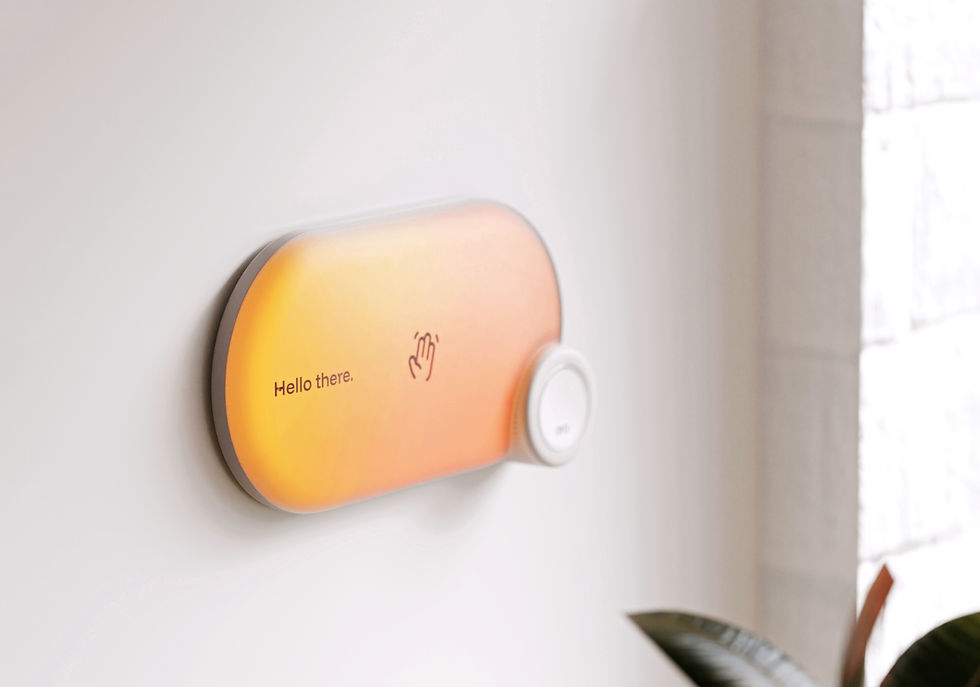
Oro is designed to gently guide seniors living alone through the disorientation experienced in the early stages of dementia.


EVERYDAY ACTION
"I have to pee, I'll be right back"
SPACE CONFUSION
"Where am I??"
TASK CONFUSION
"What was I doing??"
Dementia is a progressive condition
that causes loss of brain function.
Early stage dementia causes
sudden moments of forgetfulness
leading to fear and disorientation.
These clips from the movie Still Alice (2014) do a great job of illustrating the disorientation during early stage dementia.
%20_35.jpg)

Guidance for seniors with dementia

Oro is a reminder system that
gently guides seniors through
periods of disorientation in
the early stages of dementia.
Spring 2026 - 3 weeks
Group project with Tishya Maini, Johanna Huse & Helen Frank
(Product interface redesigned independently post-project)
Software: Rhino, Solidworks, Keyshot, Figma
Contributions: ideation, form exploration, interface design,
surface and hardware modeling, visualization
Early stage patients want to keep their independence but
experience moments of forgetfulness that shake their confidence.


Forgetting what you want to do.
Forgetting where you are.
Feeling scared and confused.
Video clips from Still Alice (2014).
“Dementia strips away
so many tiny moments
of independence.”
Wendy Mitchell, patient
Non-surveillance,
user maintains agency.
“You couldn't convince
him to do anything he
didn't want to do.”
Rashmi Haritwal, caregiver
Gentle, suggestions not instructions.
“For us, routine and
consistency became
very important.”
Andreas Estensen, caregiver
Dependable, anchored
in user's daily routine.
How might we help them
regain familiarity & security
in such moments?


warm / meditative / inviting
How might we help them
regain familiarity & security
in such moments?
How might we help them
regain familiarity & security
in such moments?
More like a home companion than a medical device...


The physical form was developed through multiple rounds of
prototyping and iteration.
Prototyping first in foam and then in CAD
and 3D printing, we worked as a team to
assimilate a shape for the product that felt
domestic, inviting and non-medical.


The core interactions were
simplified through testing and
feedback to suit the user group.
Since our user group belongs to an older
generation, we wanted to ensure the
interactions didn't feel too high tech and
had an easy learning curve. We also studied
both active and passive user interactions.

Finally the visual language
and CMF were chosen for
effective emotional resonance.
We worked carefully and meticulously
to pick color and material choices for
the details that would enhance the
form language of the product.


The interface helps users reorient themselves through open-ended
exploration of daily activities in a non-pressurizing manner.


Press the button.
Turn the knob.
The simplified and tactile interactions reduce confusion.

A range of backplate options allows
for seamless multi-room setup with
both wall-mounted and tabletop use.
%20.jpg)
%20.jpg)
%20.jpeg)
%20.jpg)